



Artificial intelligence has changed the way people approach creative and professional work. Tasks that once required several different applications can now be completed with the help of intelligent tools that can generate content, conduct research, analyze information, create visuals, and support complex projects. Flowith brings many of these capabilities together in an agentic workspace designed to make AI workflows more visual, flexible, and connected.
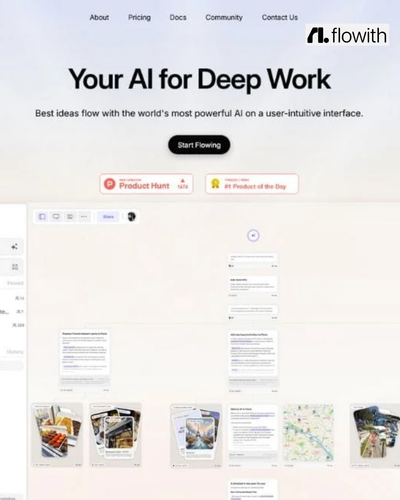
Instead of treating AI as nothing more than a question-and-answer tool, Flowith focuses on creating an environment where users can develop ideas, organize information, generate different types of content, and move between stages of a project. Its visual canvas provides a workspace where creative processes can branch out instead of remaining inside a single linear conversation.
Turn Ideas Into Complete Projects
Starting a new project can often be the most difficult part of the creative process. Whether you are developing a marketing campaign, preparing research, designing a website, creating presentation slides, or planning social media content, the first challenge is turning a broad idea into practical steps.
Flowith is designed to help users move from an initial concept toward a more structured workflow. Its Agent Neo can interpret high-level goals, plan multi-step tasks, use available tools, and adapt its approach as new information appears. This makes it useful for projects that involve several connected activities rather than a single simple request.
The visual canvas can make this process easier to follow. Instead of keeping every idea inside a long conversation, users can work with visible nodes and branches. This approach is particularly useful when a project has multiple directions that need to be compared or refined.
For example, a marketer could begin with research, develop several campaign concepts, create visual assets, and then turn the strongest direction into presentation material. Keeping these stages connected can make the overall workflow easier to understand.
Explore AI-Powered Content Creation
Creating content often requires more than writing. Modern projects may involve articles, images, videos, presentations, websites, charts, and other digital assets. Switching between different platforms for every format can slow down the creative process.
Flowith brings multiple creative modalities into its workspace. Its Agent Neo can be used for text, images, videos, slides, websites, and other project outputs, while the platform also provides access to a range of AI models.
This multimodal approach can be useful for creators who want to develop an entire project from one central environment. A writer might create an article and then develop supporting visuals, while a business owner could work on website concepts and presentation materials without completely changing workflows.
The benefit is not simply having more tools. Connecting different creative stages can make it easier to maintain the original idea throughout the project. Users can review outputs, make changes, compare alternatives, and continue developing the strongest direction.
For beginners, this can also make experimentation less intimidating. Instead of learning multiple complicated applications immediately, users can start with a clear idea and gradually explore the capabilities available within the workspace.
Simplify Research and Complex Tasks
Research can involve collecting information, comparing sources, organizing findings, summarizing large amounts of material, and turning discoveries into useful conclusions. When these activities are performed separately, important context can easily become scattered.
Flowith’s Agent Neo is designed for multi-step tasks and can use tools such as web search, file handling, code generation, and other capabilities depending on the workflow. Its documentation describes a dynamic process in which the agent can adjust its plan when results are incomplete or when a task encounters an issue.
This can be particularly helpful for projects that require several stages of research. A user can provide a broad objective and allow the agent to develop a sequence of tasks rather than manually defining every individual step.
However, AI-generated research should still be reviewed carefully. Important facts should be checked against reliable sources, especially when the information will be used in professional reports, business decisions, academic work, or published content.
The strongest workflow is therefore not about removing human judgment. It is about using AI to handle repetitive or time-consuming parts of the process while allowing the user to review, correct, and approve the important results.
Organize Knowledge in a Visual Workspace
One challenge with AI projects is maintaining useful context. A long conversation can contain valuable information, but finding a particular decision or source later may be difficult. A visual workspace offers another way to organize information.
Flowith includes a Knowledge Garden alongside its canvas-based workflow. The platform describes this environment as a way to maintain knowledge that can be used as context during projects.
This can be useful when working on projects that continue over time. Instead of starting from zero each time, users can organize relevant information and use it as part of future workflows.
For example, a business could maintain information about its products, target audience, brand guidelines, and previous research. A content creator could organize references, project ideas, and useful resources. A student could maintain materials related to a long-term research project.
Good organization remains important, however. Users should carefully consider what information they upload, especially when working with confidential business documents or private material. Access, permissions, retention, and data-handling practices should be reviewed before using sensitive information in any AI workspace.
Create More With Different AI Models
Different AI models can produce different strengths and styles. One model may be particularly useful for writing, another for visual creation, and another for complex reasoning. Having access to multiple models can therefore give users greater flexibility when choosing how to approach a project.
Flowith provides a model-selection environment that allows users to work with different AI models across its creative and agentic workflows. The platform also continues to update its model selection and features as new technologies become available.
This can be valuable for users who regularly experiment with AI. Instead of maintaining several separate workflows, they can compare outputs and select the model that best fits a particular task.
The platform’s visual approach also supports experimentation. Users can create different branches, test alternatives, and compare results without necessarily losing the original version.
For creative professionals, this can encourage a more iterative process. Rather than expecting the first AI-generated result to be perfect, users can treat it as a starting point, refine it, compare variations, and select the strongest outcome.
Choose a Plan That Fits Your Workflow
AI tools can be valuable, but choosing the right plan is important for managing costs. Flowith currently provides several pricing levels, including a free Starter option and paid Pro, Ultimate, and Infinite plans. The available models, credits, generation allowances, concurrent tasks, and other benefits vary by plan.
For someone experimenting with AI for the first time, starting with a free option can be a practical way to understand the workflow before committing to a paid plan. Users with heavier creative or professional requirements may need additional credits, models, or concurrent tasks.
The best plan depends on actual usage rather than simply choosing the most expensive option. Someone who creates occasionally may not need extensive allowances, while a professional content team or business could benefit from greater capacity.
Promotions can also change over time. Checking current pricing and available offers before subscribing is a sensible way to understand the latest options. Users should also review renewal conditions and included allowances so that the chosen plan matches their long-term requirements.
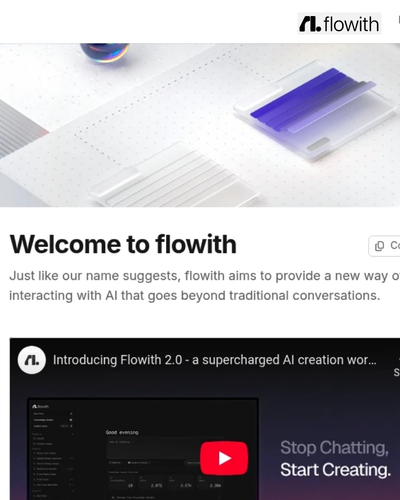
Ultimately, Flowith represents a different approach to working with artificial intelligence. Rather than placing every task inside a traditional chat interface, it combines AI agents, visual workflows, creative generation, research capabilities, knowledge organization, and multiple AI models in one environment.
Its biggest advantage can be especially noticeable when a project involves multiple connected steps. Research can lead to writing, writing can lead to visual creation, and visual concepts can develop into presentations or websites. Keeping these stages connected can make complex projects feel more manageable.
For creators, marketers, students, researchers, entrepreneurs, and professionals, the platform provides an opportunity to experiment with a more flexible style of AI-assisted work. The key is to use its capabilities thoughtfully: define the goal clearly, provide useful context, review generated results, verify important information, and maintain human control over final decisions.
As AI continues to develop, productivity will increasingly depend not only on the power of individual models but also on how effectively people can organize them into useful workflows. Flowith’s visual and agentic approach aims to make that process more connected, creative, and adaptable.
Whether you want to research a topic, develop content, generate visual assets, build a website, prepare slides, or manage a complex multi-step project, exploring the right AI workflow can help turn an initial idea into something much more complete.